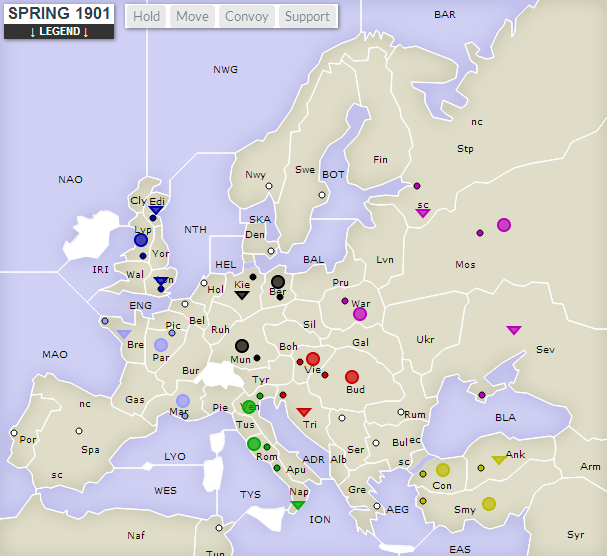
Europe stands upon a knife edge. The dawn of a new century has brought with it mechanized armies and fleets of dreadnoughts that have changed the face of warfare. Combined with national fervour and an increasingly complex web of diplomatic alliances, the fate of the whole theatre hangs perilously on the efforts of each country’s diplomatic corp. Will they prevent outright war and usher in a new age of peace for the major nations of Europe? Will they toffee. Here is a precis of the situation for each major power at the start of 1901.
Great Britain
The relative safety that the Channel and the North Sea provide Great Britain do not come without cost. With only one army to its name this island nation will be forced to make judicial use of its two navies if it hopes to expand and gain a foothold in central Europe. Expansion south involves either squabbling with France over the Iberian peninsula or making a play for Belgium or the Netherlands. As a region that experiences extensive fighting by the mid-game, the wiser course will likely be to head north and take Norway instead. Scandinavia can either by generously divided between its three surrounding countries or fought over bitterly for its three supply regions.
Herein lies the inherent difficulty for a player controlling Great Britain, as an island nation any movement made by its military will be seen as an aggressive action. To succeed the British Isles will require a seasoned diplomat with the strength of character to placate his French neighbours while simultaneously getting that vital first foothold in the mainland.
France
France begins every game with a host of possibilities. Within a couple of turns it is possible to gain two new supply centres in Spain and Portugal, quickly turning it into a major player in the Western theatre. The question is often whether a French player goes for these easy gains in the first year or is willing to focus his attention on Belgium in the opening months, safe in the knowledge that they can comfortably bring Spain and Portugal into the fold later on.
France’s main decision in these initial turns will be on deciding which neighbour to align themselves with. Do England and France crush the German war machine before it has a chance to steamroll up to the French border, or is an amphibious invasion preferable to English fleets having full control of the Baltic?
Italy
Italy is in a relatively safe position in the spring of 1901. It is difficult to invade with no immediate threat on its borders. This safe position brings with it limited opportunities to expand however, any alliances with Austria or Turkey are unlikely to be long lived as room for expansion becomes scarce. Bold convoying manoeuvres into the Balkans and Turkey can create an early lead, but these audacious strategies can often lead to overextended lines and an exposed rear for France to take advantage of. One classic play is for Italy to occupy Tunisia, although the use of its sole fleet for this action does risk diminishing Italy’s ability to control the Mediterranean in the early stages.
Turkey
A fortuitously positioned nation that can quickly gather momentum and threaten Austria, Russia and Italy at once, Turkey’s corner position propels it in one direction into the heart of Europe. The challenge for other players to contain its expansion early on is often made more difficult by the scramble for supply centres, meaning that a wily Turkish diplomat can take advantage of any early skirmishes to gain a stranglehold on the Balkans.
The Black Sea borders two of Turkey’s three initial supply centres, making it hotly contested region between the Ottomans and Russia. Gaining control of this sea by either nation will often prove pivotal in the coming years, as armies can be sent across it into the heart of their opponents homelands. A Russian-Turkish alliance can be prove unstoppable however, a tide that sweeps from East to West that is able to commit all of its forces on one front.
Russia
The easy villian in 1901, Russia looms large in every other nation’s mind. With more armies and a larger landmass than any other nation, Russia can find it difficult to gain allies early on due to its powerful position. This is offset by a huge border to maintain, meaning that a Russian ruler must be selective in where he chooses to deploy his forces and where to expand. Conflict with the Ottomans to the south can be messy and complicated, whereas the Balkans are traditionally a mosh pit between multiple players.
Looking west, Russian forces in Warsaw are ideally placed to take provinces from Germany or Austria. An alliance between these two nations can often put an end to these ambitions, but external threats from the other end of Europe can often leave these two nations with vulnerable borders for Russia to march through.
Germany
The relationship between Germany, France and England will have ramifications throughout the whole region. An early expansion by Germany into Denmark and Holland can allow it to quickly build its military strength, but becoming too large at such an early stage can force France and England into an alliance out of necessity. Crucially, forming a lasting alliance with Austria will allow Germany to withdraw its army from Munich and commit it elsewhere, either towards Warsaw or to protect against a warmongering France. Finally, if Germany is not quick enough in building fleets on its north coast then England can have unlimited access to the Baltic with its own ships, crippling a German advance into Norway or Sweden.
Austria
Beset on all sides by potentially hostile nations, for Austria to survive requires a first rate diplomat capable of preserving its precarious position in the centre of the map. Early expansion into the Balkans is necessary, but the position of an Italian supply centre on Austria’s border is often too much of a temptation to resist. Traditionally a German alliance is a necessity, but a combined German and Russian offensive can all too easily spell the end for a fledgling Austria.
 Diplomatical!