“Pitiless Mars was now dealing grief and death to both sides with impartial hand. Victors and vanquished killed and were killed and neither side thought of flight. In the halls of Jupiter the god’s pitied the futile anger of the two armies and grieved that men had so much suffering…”
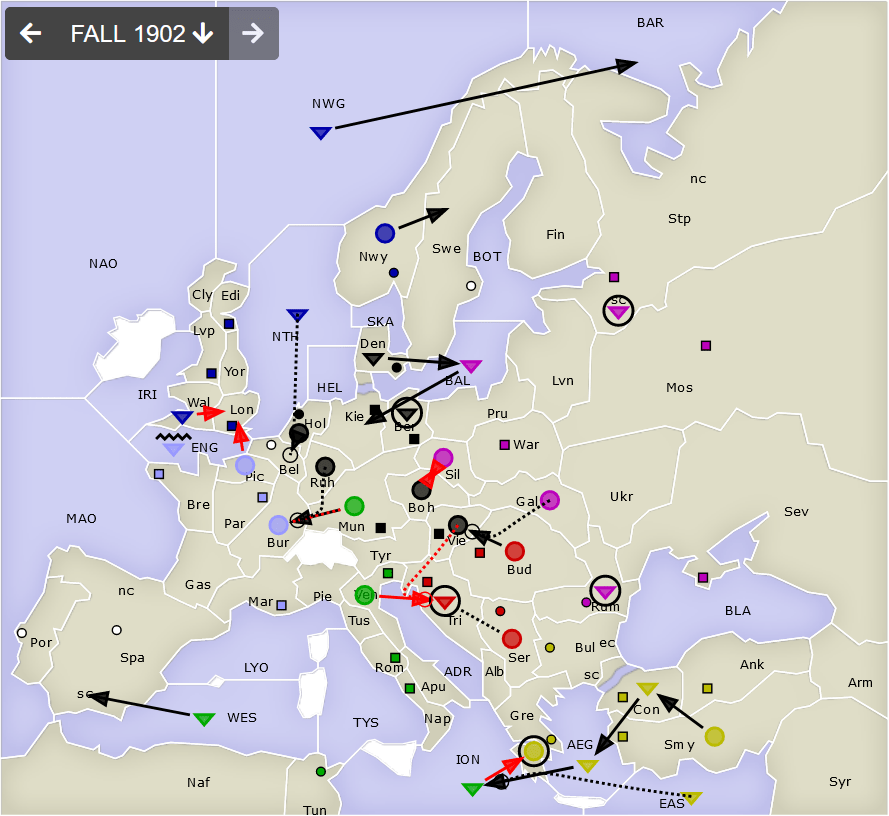
It has been a long, hard year for the nations of Europe. Germany has been at the heart of it, taking and loosing territory in equal measure. A truce between Italy seems to have formed, as instead of forcing out the Italian army garrisoned in Munich, the Germans have helped them on their way into Burgundy. Northwards, Belgium has finally come under German control, assisted by the English from the sea. This would have secured the supply centres necessary for Germany to keep its armies in the field, were it not for the lightning raid by Russia’s Baltic fleet into the Kiel shipyards. The German fleet in Denmark was too slow to intercept, meaning that Germany must surely be forced to disband one of its forces before the end of the year.
Finally, while Germany’s army to the east has fought a bitter standstill against the Russians in Bohemia, it was less fortunate in holding on to Vienna. The Austrians also managed to beat the army in Vienna back with assistance from Russian forces, placing Germany firmly on the back foot moving into winter.
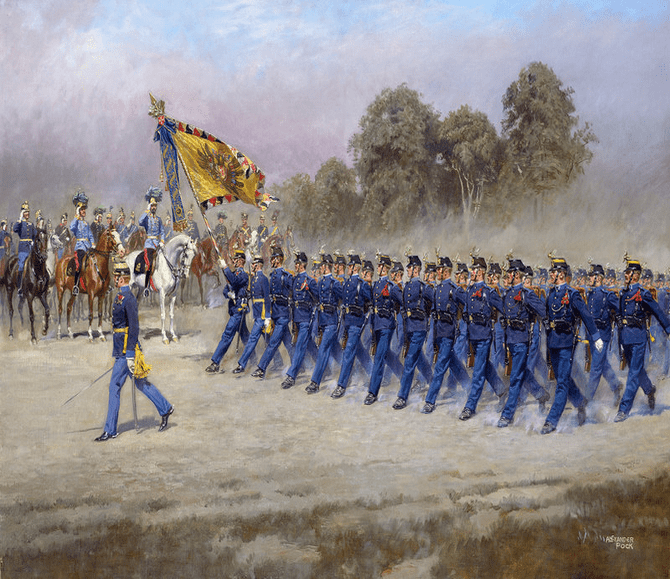
Germany’s loss was Austria’s gain however, as the kingdom has finally reclaimed its homeland. This victory also prevented a combined German-Italic attack against the fleet in Trieste, making Austria one of the clear winners this season. With a more defensible position and supply to muster new forces on the way, the kaiser seems to have done the impossible and put Austria back in contention.
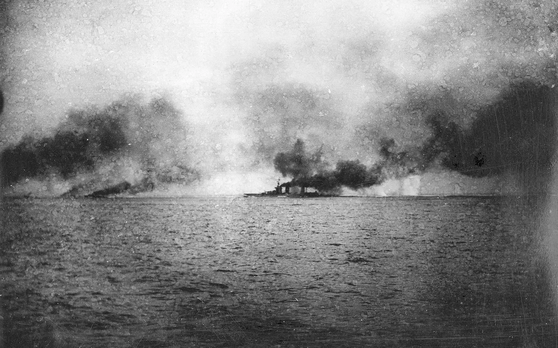
To the south, the Ottoman Empire has finished marshalling its considerable resources and has finally begun the march westwards. With a seemingly unbreakable alliance with Russia forming, the armies of the Sultan have only one route of conquest available to them, which brings them straight into contact with Italy’s forces in the Adriatic. The lone Italian fleet was swatted aside by the combined navies of the Ottoman’s, cementing their foothold in the Peloponnese and allowing further passage into the seas beyond. The lone Ottoman army must soon come into conflict with the Austrian forces in Serbia, but for now the greatest threat to the other European powers are the Ottoman fleets, with free reign to terrorise the Mediterranean.
With the destruction of its fleet in the Adriatic, Italy must now rethink its plans for naval conquest. A rapid redeployment of forces must now take places from Rome and Naples to counter the Ottoman threat, but already Italy’s holdings in Tunis look perilously undefended. There will be a bitter fight on the high seas in the coming months between these two powers for control of so many important coastal settlements.
On land, results have been a mixed bag for Italy. With the assistance of erstwhile enemies the Germans, Italian forces have been able to punch through the French lines stationed in Burgundy and into the Gallic heartland. This lost Italy control of the critical Munich supply centre, but has now placed its forces within striking distance of several French supply centres. Elsewhere Italian forces stationed in Venice made a solid attempt at claiming Trieste from the Austrians, again with the support of Germany, but canny manoeuvres from Austria prevented any gains. The occupation of Spain has gained Italy the supplies its needs to build crucial new forces over the winter, but nevertheless this central power has been left in a precarious position with its forces spread very thin.
Russia’s main strategic play this season was the surprise occupation of Kiel by its Baltic navy. With the German navy too slow to intercept, this has robbed Russia’s long-time enemy of the crucial supplies it requires to keep its forces in the field. Surrounded on all sides by German forces grimly determined to retake one of their home regions, it seems unlikely that the fleet will last until the spring, but perhaps this was the key strategic decision to place Germany on the back foot. Certainly, without the supplies to support its forces Germany will have to rethink its front lines.
France finally attempted the unthinkable and sent its armies across the channel, straight to the capital of England. The amphibious landing would have succeeded where it not for the last minute arrival of the Home Fleet, under the command of Vice-Admiral Noel. No side was able to achieve the upper hand, with French forces retreating back to Calais with the support of the French fleet still sat menacingly in the channel, while the British navy was forced to regroup off the Welsh coast. Such an audacious plan will certainly put the two powers at odds for the coming months, and it is hard to see how trust will be rebuilt following such a bold attack. Elsewhere, French forces in Burgundy were forced to withdraw after the Italian invasion, and have beaten a hasty retreat back to Marseille.
Aside from its desperate defence of the capital, the rest of the English forces have headed further east. The British army stationed in Norway have made the long trek over the Keel into unoccupied Sweden. A nation that has so far managed to stay neutral among the European powers, despite fighting between the British and the Russians last year over its resources, the final Scandinavian country has come under British control. England’s most northerly fleet stationed in the Norwegian Sea has now set sail for the Barents Sea, almost within striking distance of St Petersburg. Is this the start of a British invasion, or is the presence of a British fleet so far north only intended as a deterrent against further plans from the Winter Palace?
 Diplomatical!