“The midwife of history is violence.” – France Joseph I, Emperor of Austria
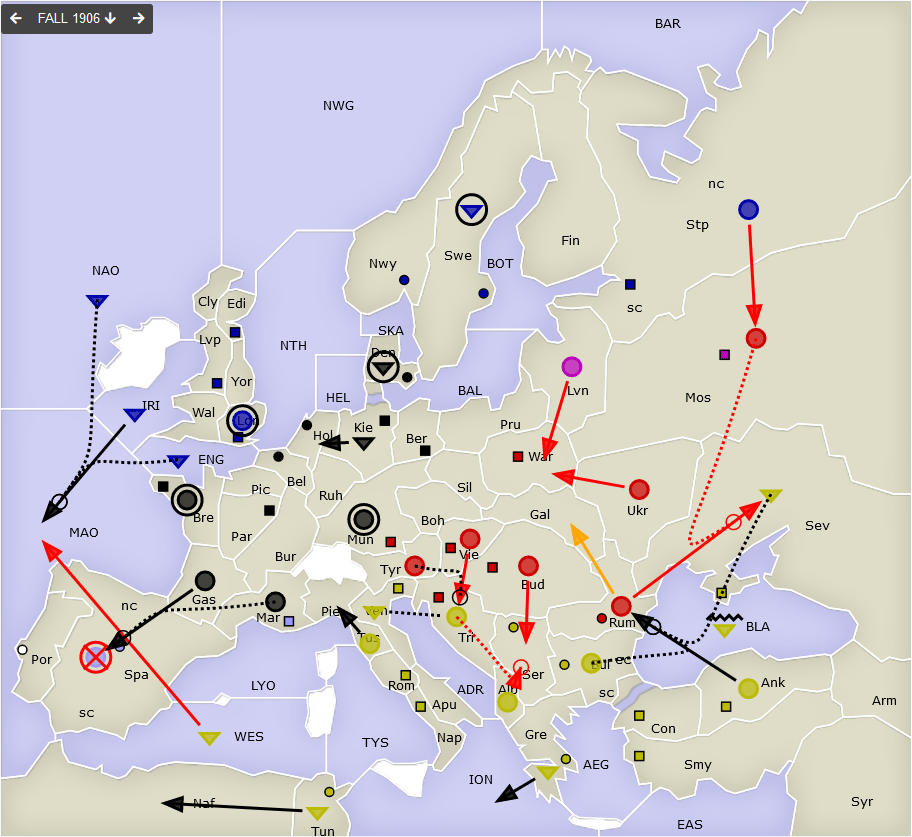
We start with Germany, a nation that has had a quiet yet fruitful year. After months of fierce fighting on the eastern front, most German force have been given a reprieve and allowed to rest in their occupied territories. The only military operation was the inevitable occupation of Spain and the fall of the French Republic. A cynic could view the holding of forces in Brest, Holland and Denmark as German suspicion of English invasion after so many year of faithful cooperation, but this correspondent dismisses these foolish theories.
Across the Channel, the English navy has re-doubled its efforts to occupy the Atlantic. A combined English fleet easily beat back a token Ottoman force and now lies poised to take Portugal, a country that has miraculously remained neutral through this entire conflict. Duty bound by its alliance with Portugal dating back to 1373, England will likely claim that its occupation is a national duty. On land, the BEF made a token effort to take Moscow from the Austrian force stationed there, but was easily rebuffed by the defenders.
Now reduced to a single army, Russia made a last ditch attempt to occupy Warsaw and secure key supplies that it needed to remain operational. A counter-attack by Austria denied them access however, and it is understood that the Tsar has ordered his officers to disband the army and signal a general surrender. After years of conquest and brutal fighting on the eastern front, it is disheartening to see a once great nation reduced to political exile on the shores of the Baltic.
Austria staged a valiant counter-attack against recent losses, but none proved capable of providing a breakthrough. An attack on Sevastopol was cut off by an Ottoman amphibious invasion across the Black Sea, and the Ottoman defenders in Trieste proved too dug-in for Austrian forces to prevail. Finally an Austrian army attempted to push south into Serbia, but this too was foiled by one of the many Ottoman armies in the region. As the year comes to a close, it is likely that large numbers of Austrian forces will be forced to stand-down as their supply lines fail to support them.
Strengthening his vice-like grasp of the Mediterranean, the Ottoman Sultan continues to push his armies ever westward. The sea-borne invasion of Rumania has proven a success, securing the vital Black Sea port of Constanța after a failed naval invasion earlier in the year. Crucially, Ottoman gains across the Balkans were held on to as well, bringing with them the resources needed to marshal even more forces back in Asia Minor. At sea, Ottoman fleets have left port in Tunis and headed into North Africa, likely to support another attempt to force passage round Spain into English waters.
 Diplomatical!