The great city of Vienna has not escaped this conflict unscathed. In its early stages a German division occupied the city, breaking the decades old “Doppel Allianz”. Eventually retaken by Austrian forces, it also bore the brunt of repeated Ottoman assaults.
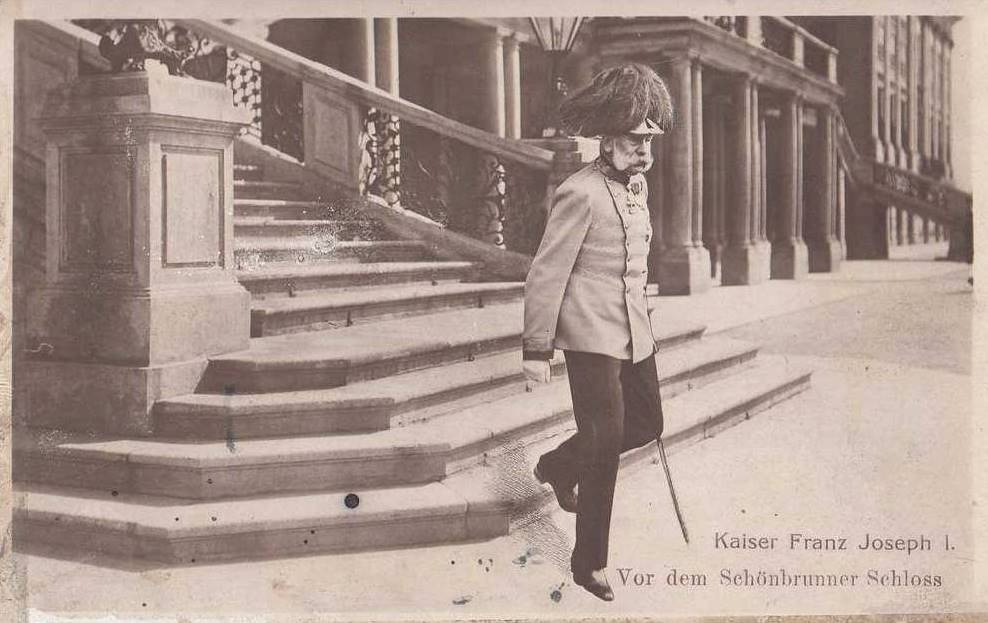
I met the Kaiser in the gardens of Schönbrunn Palace in late April; it has been several months since the autumn armistice of 1907. Despite the losses his kingdom has suffered, evident in the damage sustained by the city that is still being repaired, the old king was in good spirits.
Austria’s fortunes – and your own – changed dramatically over the course of the war. Is there any moment you are particularly proud of?
“A favourite of mine, was when I realised that Italy’s move into Munich was a phoney stab – using this information I was able to push the German’s back out of Vienna and liberate Trieste!”
The Kaiser laughs and slaps his knee, fondly remembering the ruse.
“At the same time, I had my agents feed bogus information to the British, informing them that the Russians were planning an assault on Berlin. Of course I knew the British would go scurrying to the Germans at once with this information, and the Germans dutifully entrenched themselves in their capital, allowing a Russian fleet to sail freely into Kiel!“
The King looks mournfully around at the palace he spent much of his adolescence in, still bearing the scars of German occupation and Ottoman assault. His faces hardens.
“A debt repaid.”
But that wasn’t Austria’s finest hour was it?
A smile engulfs his face again, lifting the darkened features.
“Aha! The devastating stab against Russia, I think it is fair to say it knocked them out of this war. The Tsar was far too trusting. Being the leader of a country like Austria, nestled amongst other powerful nations, is never boring.”
Austria survived this war, but just barely. Where do you think things went wrong?
“Before he died, I received some helpful advance from the King of Italy. He said ‘trust your gut’. My initial reaction was that I couldn’t work with the Ottomans, because I would be vulnerable to Italy. But with Italy and Germany working together, I had no one else to turn to.
It was never going to work, this Austro-Ottoman alliance – I had to hope my betrayal of Russia would convince the Sultan that it was worth keeping me as an ally rather than seeking victory for himself.” The king sighs. “But as you can see, that did not pan out.”
A high risk strategy certainly, but you were short on options. What was your initial strategy at the outset of the war?
“Do or die, as I say. The strategy I initially formulated with my generals was an all-out war with the Ottomans for control of the Balkans, letting the Italians control the Mediterranean. Then, I would use captured resources to taken on Russia.”
If you could go back to 1901, is there anything you would have done differently?
The Kaiser lets out one last, uproarious laugh.
“No, euntes magnus et vade in domum tuam, as I like to say. I was an emperor, now reduced to an archduke exiled in his home city. Still better than Napoleon’s exile, don’t you agree?”
Centuries ago, the city of Vienna was fortified by the Romans to guard against enemies of Rome to the north – in the dark, dangerous forests of Germania. Reduced to a single city, will this former kingdom now perform the same duty against the resurgent Ottoman Empire to the south?
 Diplomatical!